
Why can I get relaxed before bed, but then the stress floods back when it’s bedtime? (An explanation for therapists and psychology enthusiasts)
There are many reasons this could be happening, but if you’ve already tried everything to ease or cope with nighttime anxiety, but it’s not budging, it could be conditioned arousal.
If you ever took Psych 101, you may remember learning about classical conditioning and Pavlov's dogs.
Classical Conditioning is a type of learning where a neutral stimulus (a bell) can be so frequently paired with an unconditioned stimulus (food) which elicits salivation (an unconditioned response). Over time, the bell (now a conditioned stimulus) elicits salivation (a conditioned response) with no food present.
If your head is spinning, and you just want the TLDR, skip ahead to the section titled “Let’s walk through an example of how this can happen:”

In short, the dog was trained to salivate to the bell even when there wasn’t food. This wasn’t something the dog was consciously thinking about, it wasn’t “taught” in the usual way, this wasn’t even done on purpose. Classical conditioning was discovered accidentally.
Likewise, nighttime anxiety can accidentally become a conditioned response to being in bed
I often hear this in statements like “I can get totally relaxed before bed and I’m not worried about anything in particular, but the minute I get into bed (or even think about the bed), I get really stressed out of nowhere”
The bed (a neutral stimulus) was paired with stress (an unconditioned stimulus) so much that now the bed becomes a conditioned stimulus for the stress response.
Let’s walk through an example of how this can happen:
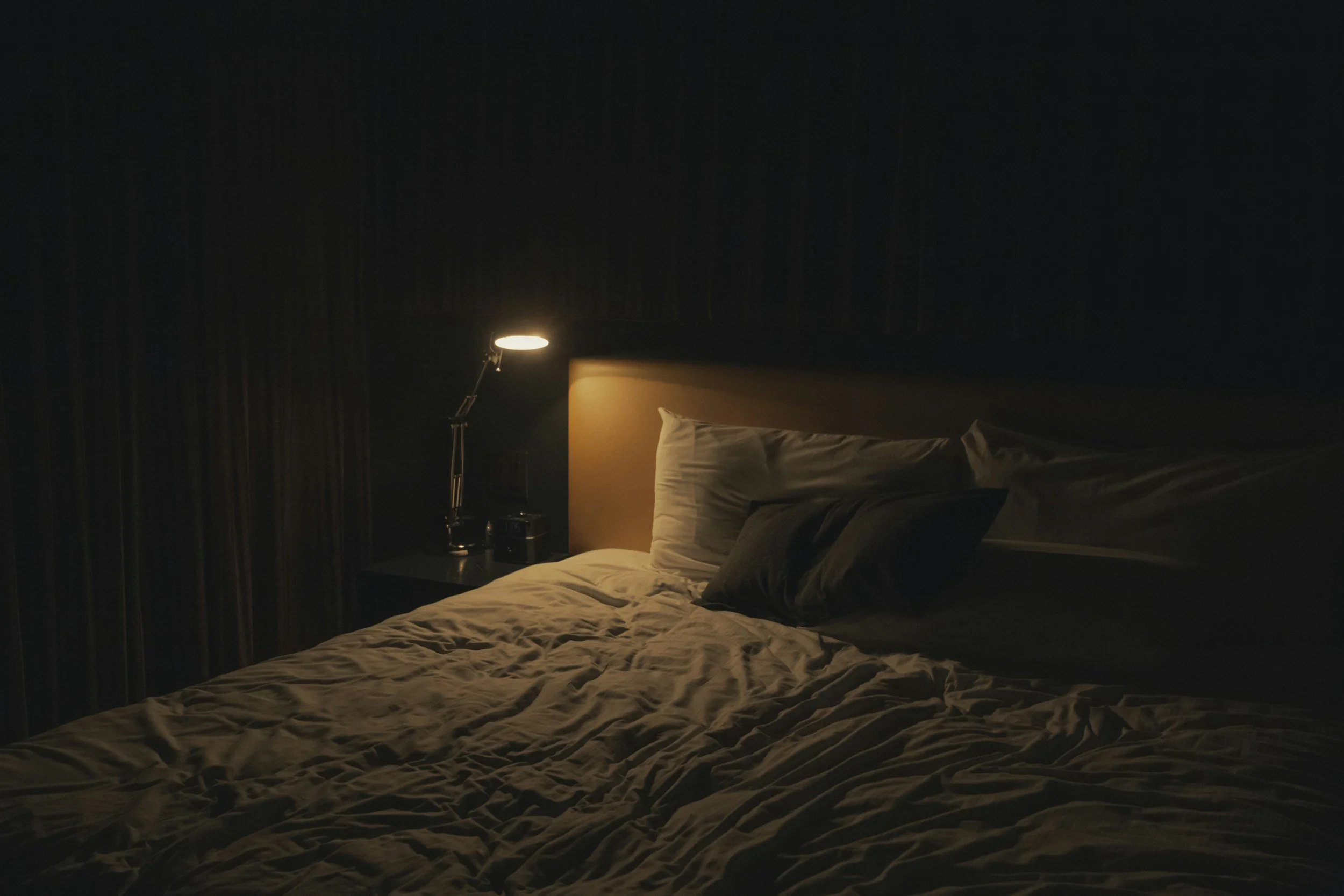
Laura has always thought of the bed as her safe space, she feels comfortable there. She is going through a period of high stress at work, at the end of the day, all she wants to do is lie in bed watch videos- so she does.
She gets into bed and tries not to think about the stress of the day. She watches videos that make her feel everything from excited, to sad, to afraid she experiences the stress response including increased heartrate, sweating etc. Despite the distractions, she also finds herself worried about the day’s events which also trigger stress.
Over time, an association builds between the bed, and the stress response.
Laura notices she’s feeling even more stress than before and recognizes that the screen time in bed probably isn’t helping, so she moves the phone across the room.
However, now, she lies in bed wide awake and still experiencing the stress response in bed as her body has been trained to associate the bed with stress.
She tries to rationalize with herself, reminds herself that she’s safe, and tries relaxation exercises but none of it works.
She can get very relaxed during the day, but when it is time to get in bed, the stress response comes on strong, seemingly out of nowhere.
She’s stuck, having tried everything she can think of. It is starting to affect her sleep and her days which worries her even more.
Luckily, this isn’t permanent.
Going back to Pavlov's dogs, the salivation in response to the bell over time could be unlearned or "extinguished" by repeatedly ringing the bell without presenting food.
So how does that apply to Laura’s situation?
If Laura and I were to work together, I would explain conditioned arousal and answer all her questions.
Next we would set up a clear step-by-step plan using classical conditioning to extinguish or unlearn that association between the bed and the stress response, and help the body re-learn the association between the bed and rest/calm so the bed can be her safe space again.
After this process, it’s common for people to say “I can’t believe it, but even though I didn’t have the perfect day or a perfect wind-down routine, I got into bed, and my muscles relaxed and I felt at ease, the bed is my safe space again.”

Hi, I’m Kasryn! The author of this post and the therapist behind BodyMind Alliance.
(Pronounced Kaz-rin)
I love helping clients discover how great-quality rest improves their lives.
Learn more about me